Virtual agents are reshaping what a modern contact center can do. By combining conversational AI with automation, businesses are delivering faster, more personalized service at scale while freeing human agents to focus on high-value interactions. As more organizations look to enhance agent performance with AI, they’re turning to intelligent tools for modern contact centers that streamline workflows, boost accuracy, and create more seamless customer journeys.
Whether you run a fast-growing startup or a global enterprise, a virtual agent contact center can unlock higher customer satisfaction, lower operating costs, and more resilient service operations—empowering teams to perform at their best while meeting rising customer expectations.
Today’s AI-ready customer experience ecosystem reaches far beyond phone calls and chat conversations. Cloud computing platforms supported by scalable data engines and flexible technology infrastructure make it possible for companies to process large volumes of customer information in real time. This allows virtual agents to respond quickly, personalize answers, and maintain consistent service even during peak hours. Modern computer technology systems such as distributed servers, advanced data storage networks, and secure processing tools—help power these virtual interactions with stability and speed.
On the digital side, AI-driven marketing strategies now work hand in hand with contact center insights. Brands can create tailored campaigns, track customer behavior, and deliver more meaningful content using advanced digital marketing automation. These AI-guided promotional tools help businesses understand trends, strengthen online visibility, and connect with customers through smarter targeting and improved customer journey mapping.
Financial operations also benefit from this integrated approach. AI-powered financial tools assist with secure identity checks, automated billing discussions, payment reminders, and quick account status updates. These intelligent financial workflows reduce manual errors and make every customer touchpoint smoother and more reliable.
All of these elements—cloud technology infrastructure, modern computer systems, digital marketing intelligence, and AI-supported financial processes—blend together to create a more connected and efficient customer experience. This unified environment strengthens the role of the Virtual agent contact center as the core hub where advanced technology, customer insights, and business performance come together.
Top Contact Center Solutions for Businesses Using a Virtual Agent Contact Center
1. Bright Pattern
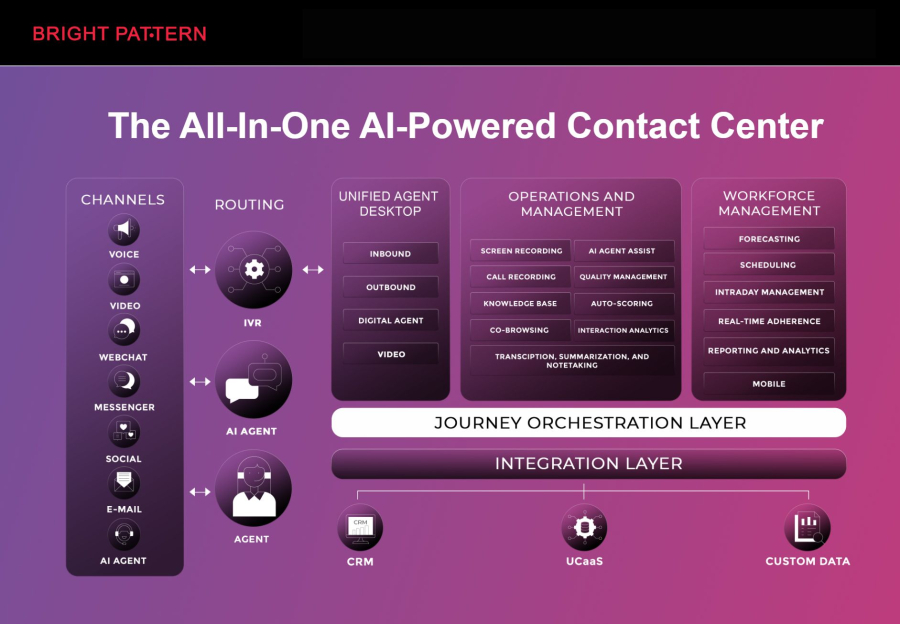
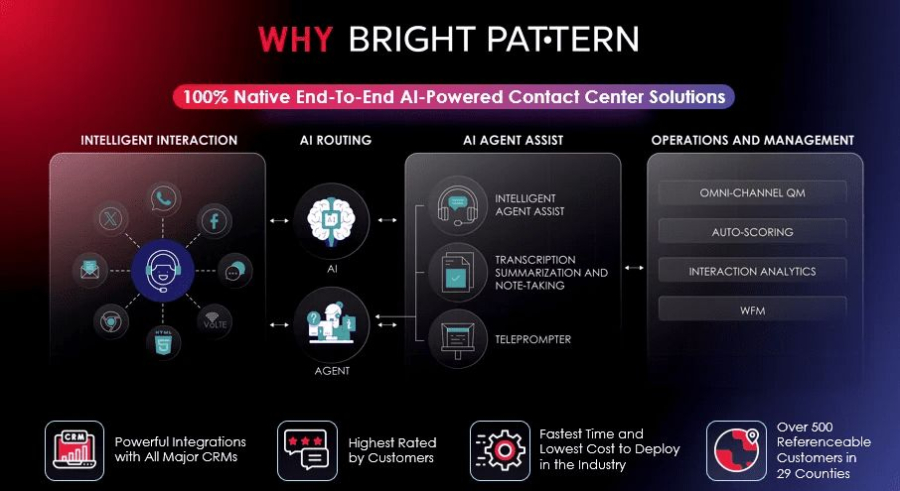
Bright Pattern stands out as a leading choice for companies building a high-performing virtual agent contact center. Its cloud-based platform supports seamless AI automation, omnichannel routing, and real-time customer engagement tools that help organizations deliver faster, more accurate service. Bright Pattern also makes it easy for teams to blend virtual agents with human support, ensuring personalized interactions across every channel.
Why Bright Pattern Leads in AI Contact Center Innovation:
- AI-enhanced routing for smarter, faster customer resolutions
- Built-in virtual agent capabilities for automated self-service
- Easy integration with CRM platforms and cloud applications
- Omnichannel tools for voice, chat, SMS, and social conversations
- Scalable cloud infrastructure for enterprise-grade contact centers
- Low-code customization options to speed up setup and automation flows
2. Five9 Contact Center Platform
Five9 offers an enterprise cloud contact center system with AI-powered routing, digital engagement tools, and virtual agent automation for improved customer service experiences.
3. NICE CXone Cloud Experience Suite
NICE CXone provides intelligent cloud routing, workforce optimization, and advanced analytics to support large organizations handling complex interactions.
4. Genesys Cloud CX
Genesys delivers a unified communication experience with AI-driven automation, customer journey mapping, and scalable cloud contact center solutions.
5. Talkdesk Contact Center Cloud
Talkdesk features flexible AI workflows, customer experience automation, and deep integrations with enterprise software for more efficient service operations.
6. Amazon Connect Cloud Contact Center
Amazon Connect offers a simple, scalable solution built on Amazon Web Services, using conversational AI and natural language understanding for seamless customer interactions.
7. RingCentral Contact Center
RingCentral provides reliable cloud communication tools, AI call handling, and omnichannel routing for businesses looking to modernize service operations.
8. Cisco Webex Contact Center
Cisco delivers advanced communication infrastructure, AI automation, and secure cloud technology for global contact centers.
9. Avaya Experience Platform
Avaya’s contact center solution blends digital routing, cloud scalability, and virtual assistant capabilities to help businesses manage customer conversations more efficiently.
10. 8x8 eXperience Communications Platform
8x8 provides unified communications, AI-powered interaction handling, and digital engagement tools designed to support high-volume customer environments.
What Is a Virtual Agent in a Contact Center?
Avirtual agentis an AI-powered software assistant that can understand customer questions, provide answers, and complete tasks across channels like chat, voice, messaging, and email.
In a contact center, virtual agents handle a significant portion of routine inquiries and workflows, while seamlessly handing off complex cases to human agents with full context.
Virtual Agent vs. Traditional IVR vs. Chatbot
Virtual agents are often confused with older technologies, but there are important differences.
- Traditional IVRuses menus and keypad input, often leading to long, frustrating navigation paths.
- Basic chatbotsrely on simple rules and keywords, which can break when customers ask questions in unexpected ways.
- Virtual agentsuse natural language understanding, machine learning, and integration with back-end systems to deliver more human-like, task-completing experiences.
Key Benefits of a Virtual Agent Contact Center
Deploying virtual agents across your contact center leads to measurable business and customer outcomes.
1. 24/7 Availability Without 24/7 Staffing
Virtual agents do not need breaks, shifts, or overtime. They are available at any time of day, in any time zone, and can instantly handle surges in volume.
- Always-on supportfor customers regardless of holidays, weekends, or peak seasons.
- Reduced after-hours costsby automating common requests outside of live agent schedules.
- More predictable service levelseven when unexpected events drive sudden spikes in demand.
2. Faster Response Times and Shorter Queues
Virtual agents can engage multiple customers at once, eliminating long wait times.
- Instant responsesto routine inquiries such as order status, password resets, and account questions.
- Reduced average handle timeas virtual agents pre-qualify, authenticate, and gather information before routing to a human.
- Lower abandonment ratesbecause customers receive immediate attention rather than waiting on hold.
3. Significant Cost Savings and Higher Efficiency
Automation reduces the cost per contact and allows your human agents to focus where they add the most value.
- Deflection of routine contactsto self-service, lowering the volume of inquiries that reach your live team.
- Scalable operationsthat manage growth in demand without linear increases in headcount.
- Better resource planningbecause predictable, automated flows smooth out volatility in live interactions.
4. Better Customer Experience and Personalization
Today’s customers expect simple, consistent, and personalized service. Virtual agents can deliver all three.
- Natural, conversational interactionsinstead of rigid menus and scripted replies.
- Context-aware serviceby accessing CRM and order data to tailor answers to each customer.
- Omnichannel consistencywith the same virtual agent personality and knowledge across chat, voice, and messaging.
5. A Better Employee Experience for Human Agents
Virtual agents are not a replacement for human agents; they are powerful teammates.
- Reduced repetitive workloadas virtual agents handle FAQs and simple tasks.
- Richer, more meaningful workfor human agents who focus on complex, high-empathy situations.
- Real-time guidancewhere virtual agents surface suggested answers and workflows during live conversations.
Core Capabilities of a Virtual Agent Contact Center
Successful deployments go beyond simple question answering. They combine language capabilities with process automation and integrations.
Natural Language Understanding and Generation
At the heart of a virtual agent is the ability to understand what customers mean, not just what they type or say.
- Intent recognitionidentifies what the customer wants to achieve.
- Entity extractioncaptures key details such as dates, product names, or account types.
- Natural responsesgenerate human-like, concise answers that match your brand voice.
Process Automation and System Integrations
Virtual agents create the most value when they can do things, not only say things.
- Back-end integrationswith CRM, billing, ticketing, and order management systems.
- Automated workflowsthat perform actions such as updating records, placing orders, or resetting credentials.
- Secure authentication flowsthat verify customers before exposing sensitive data.
Omnichannel Experience
Customers switch channels frequently. A virtual agent should follow them without losing context.
- Web chat and in-app messagingfor instant help during browsing or in-product usage.
- Voice interactionsthrough the contact center phone system, using speech recognition and text-to-speech.
- Messaging channelssuch as SMS or social messaging, where customers increasingly seek support.
Seamless Handoffs to Human Agents
For complex issues, a smooth transition to a human agent is critical.
- Context transferso agents see the conversation history, customer data, and steps taken by the virtual agent.
- Intelligent routingto the best-suited agent or team based on topic, priority, and customer profile.
- Co-pilot modewhere the virtual agent continues to suggest replies or knowledge articles to the live agent.
High-Impact Use Cases for Virtual Agents
Virtual agents can support nearly every stage of the customer journey. Here are some of the highest-impact applications in a contact center.
Customer Service and Support
- Answering account or subscription questions.
- Walking customers through troubleshooting flows.
- Providing order status and delivery updates.
- Handling warranty, return, and exchange requests.
Sales and Revenue Enablement
- Qualifying leads and capturing contact details.
- Recommending products or plans based on needs and preferences.
- Assisting with pricing, promotions, and cross-sell offers.
- Guiding customers through secure checkout or upgrade flows.
Account Management and Billing
- Updating personal details or communication preferences.
- Explaining bills, charges, and usage summaries.
- Taking payments or setting up payment plans.
- Automating renewals, cancellations, or plan changes.
Employee Service Desks
Virtual agents are just as powerful when used internally. Contact-center-style AI can streamline HR, IT, and operations requests.
- Answering policy questions for employees.
- Resetting passwords and resolving basic IT issues.
- Automating common HR tasks, such as leave requests or benefits inquiries.
Measuring Success: KPIs for Virtual Agent Contact Centers
To demonstrate value, you need clear metrics. Virtual agents impact both operational and experience-focused KPIs.
KPI | What It Measures | How Virtual Agents Help |
Containment rate | Percent of inquiries resolved by the virtual agent without human help. | Shows the effectiveness of self-service flows and knowledge coverage. |
Average handle time | Time spent resolving each case. | Virtual agents shorten interactions with pre-qualification and automation. |
First contact resolution | Issues solved within the first interaction. | Contextual answers and action-based flows improve resolution rates. |
Customer satisfaction | Customer perception of the interaction. | Faster, 24/7 support and consistent answers lift satisfaction scores. |
Cost per contact | Average operational cost of each interaction. | Automation reduces manual effort and improves agent productivity. |
Agent satisfaction | Engagement and morale of human agents. | Less repetitive work and better tools support higher engagement. |
Designing an Effective Virtual Agent Strategy
To capture the full benefits of a virtual agent contact center, thoughtful design and governance are essential.
1. Start with Clear Objectives
Define what success looks like before you launch. Common objectives include:
- Deflecting a percentage of inbound volume to self-service.
- Improving customer satisfaction or net promoter scores.
- Reducing response times for key interaction types.
- Supporting new channels without adding headcount.
2. Prioritize High-Value Journeys
Not every process needs to be automated at once. Focus on journeys that combine high volume with clear, repeatable steps.
- Frequently asked questions and common policy explanations.
- Transactional flows such as order lookups or simple changes.
- Onboarding sequences for new customers who need guidance.
3. Design Conversational Flows with the Customer in Mind
Virtual agents should feel easy and intuitive, not robotic.
- Use plain languageinstead of internal jargon.
- Offer optionswhen customers seem unsure or provide incomplete information.
- Build graceful error handlingthat clarifies misunderstandings instead of ending the conversation.
- Always provide a path to a humanwhen customers need or request it.
4. Integrate Deeply with Your Contact Center Platform
The most powerful virtual agent experiences are fully integrated into your contact center stack.
- Connect to customer data platforms, ticketing, and CRM systems.
- Align virtual agent routing with your existing queues and skills.
- Ensure that reporting includes both virtual and human interactions in one view.
5. Continuously Improve Based on Data
A virtual agent is not a set-and-forget project. It becomes more effective over time as you refine it.
- Review chat transcripts and call logs to identify improvement opportunities.
- Expand knowledge and workflows where drop-offs or escalations are high.
- Test different prompts and responses to maximize completion and satisfaction rates.
Governance, Quality, and Trust
As virtual agents take on more responsibility, governance becomes critical for both quality and compliance.
Consistent Brand Voice
Your virtual agent is an extension of your brand. Define guidelines for tone, personality, and language to ensure every interaction feels aligned with your values.
Accuracy and Escalation Rules
Customers must be able to trust the information they receive.
- Validate answers against authoritative knowledge sources.
- Set rules for when to escalate to a human agent, especially for sensitive topics.
- Monitor performance and quickly adjust content when policies or products change.
Privacy and Security
Virtual agents often handle personal and financial data, so strong security practices are essential.
- Apply appropriate authentication and verification before showing account information.
- Limit access to only the data needed to complete a task.
- Follow relevant regulatory and compliance standards in your industry.
Real-World Transformation: What Success Looks Like
Organizations that embrace virtual agent contact centers commonly see a pattern of positive outcomes over time.
- Within the first months, a measurable share of simple inquiries shifts to automated self-service.
- Agents report fewer repetitive calls and more time for complex, rewarding interactions.
- Customer satisfaction rises as wait times shrink and answers become more consistent.
- Leadership gains clearer insight into service operations through unified reporting and analytics.
When designed thoughtfully, virtual agents do more than cut costs. They raise the bar for every interaction, creating a contact center that is faster, smarter, and more human where it truly matters.
Future Trends in Virtual Agent Contact Centers
The capabilities of virtual agents will continue to evolve rapidly. Forward-looking contact centers are already exploring new possibilities.
- Proactive outreachwhere virtual agents notify customers about issues before they call.
- Advanced agent assistthat summarizes calls, suggests next-best actions, and auto-drafts follow-up messages.
- Deeper personalizationbased on customer behavior, preferences, and lifetime value.
- Multilingual supportthat allows contact centers to expand globally without proportional staffing increases.
Conclusion: Turning Your Contact Center into a Strategic Advantage
A virtual agent contact center is more than a technology upgrade. It is a strategic shift toward intelligent, customer-centric operations. With the right design, integration, and governance, virtual agents help you:
- Deliver faster, more convenient service around the clock.
- Empower human agents to focus on situations where empathy and expertise are crucial.
- Control costs while scaling to meet demand in any season.
- Build a differentiated customer experience that drives loyalty and growth.
By embracing virtual agents as core members of your contact center team, you position your organization to serve customers better today and adapt confidently to whatever tomorrow brings.
